

 Home
Home Register
 Login
Login Album list
 Last uploads
 Last comments
 Most viewed
 Top rated
 By date
 My Favorites
 Search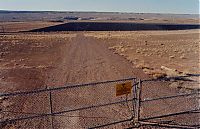
Tuba City Mill
Location: The former Tuba City mill site is located approximately 5 miles east of Tuba City, Coconino County, Arizona, south of U.S. Highway 160 on the Navajo Indian Reservation. It is 85 miles north of Flagstaff, Arizona, and near the Hopi Indian Reservation.
Background: The uranium ores processed at the Tuba City mill came largely from sites in Arizona: the Orphan Lode mine within the Grand Canyon National Park, mines in the Cameron area and adjacent areas, mines in the Monument Valley district, and ores purchased by the U.S. Atomic Energy Commission (AEC) at the Tuba City ore buying station and at other AEC ore buying stations1, including the Globe ore buying station, Gila County, Arizona.2 3
Orphan Lode mine - Uranium mineralization was identified by a U.S. Geological Survey geologist in April 1951 in old copper mine workings at the Orphan mining claim, a lode claim located in 1893 and patented as a copper prospect in 1906. 4 5The mine site is near Grand Canyon Village and about 1,100 feet below the south rim of the Grand Canyon of the Colorado River. Private exploration drilling in 1955 confirmed a high-grade uranium-copper deposit on the claim. The Orphan Lode deposit was in the upper reaches of a vertical, nearly circular, solution-collapse breccia-pipe structure. It is exposed on the canyon wall near the Coconino Sandstone-Hermit Shale (Permian) contact. 6 The pipe structure extends downward from outcrop through sedimentary rocks of Permian and Pennsylvanian ages and bottoms near the middle of the Redwall Limestone (Mississippian age), a vertical distance of about 1,660 feet. 7 The collapse material in the pipe consists of poorly consolidated sand fill, sandstone and claystone breccias with varying calcite cementation, and limey siltstone. 8 9 Uranium ore bodies associated with the pipe occurred as irregular masses in the collapsed material that fills the pipe and in rocks associated with the pipe's peripheral, annular-ring shear zone that defines the border of the pipe. 10 11 Some ore also extended outside the lode claim boundary and onto land belonging to the National Park Service.12 The ore was mined to a depth of about 585 feet, but uranium mineralization associated with the pipe structure is present below that mine level.
Development work at the Orphan Lode mine began in 1953. A three-tower, aerial tramway was completed in March 1955 from the canyon rim to service the mine site. A new 1,800-foot tramway with eight-towers replaced the old one in May 1956. The tramways had limited capability for moving materials to and from the mine. To expand ore production, a 1,590-foot, 2½ compartment mine shaft was sunk on the claim behind the canyon rim from May 1958-January 1959. The shaft was connected to the mine through a 1,200-foot crosscut at the 400 level. Mine development costs at the Orphan were high, as all mined materials had to be transported off site. Cut and fill methods, which involved handling and rehanding waste rock in the underground mine, were used when possible to save on costs for hoisting and surface storage. Mine waste rock could not be stored on National Park Service (NPS) land. Some waste rock excavated during mine-shaft and crosscut construction was used by the NPS for road projects in the park.
The first shipment of Orphan Lode ore went to the AEC's ore buying station at the Tuba City mill in April 1956. Most of the ore mined from the Orphan was hauled to the Tuba City mill for processing. Some ore was shipped in 1958-1960 to mills in Utah and New Mexico, when the Tuba City mill could not take the ore. In 1959 and 1960, some Orphan Lode ore was also shipped to an Ambrosia Lake, New Mexico, alkaline-leach mill that could treat the high-lime ore. 13
Throughout its life the Orphan Lode mine was operated by several owners.14 Cotter Corporation, the last owner, shipped and processed ore from the mine at its Canon City, Colorado, mill from late 1967-early 1969. In April 1969 the Orphan Lode mine was permanently closed due to the high cost of shipping the ore to the Canon City mill. 15
The total Orphan Lode mine ore production (April 1956-April 1969) was 500,432 tons ore containing 4,286,254 pounds U3O8. 16 About 32 percent of the total uranium produced was recovered from ore mined on National Park Service land. The highest grade monthly ore shipment was 726 tons that averaged 2.29 percent U3O8. 17 Some 6.68 million pounds of copper and about 107,000 ounces of silver also were recovered from the Orphan Lode ore .18
Cameron uranium area - Uranium deposits occur in the Cameron area in an area that extends about 30 miles north-south and 12 miles east-west near the town of Cameron, Arizona. 19 The area extends across parts of the Painted Desert and Ward Terrace in the western part of the Navajo Reservation. In the Ward Terrace area east of Cameron, uranium minerals were discovered in 1950 on an outcrop of the Kayenta Formation (Lower Jurassic). 20 From mid 1951 to the spring of 1952, several shipments of uranium ore from small deposits in this area were sent to the AEC ore buying station at Monticello, Utah. In early 1952 ore was also shipped to the AEC buying station at Shiprock, New Mexico. 21
In 1952, uranium was discovered on Chinle Formation (Upper Triassic) outcrops near Cameron by a Navajo prospector who was conducting surface radiometric reconnaissance on behalf of the AEC. 22 Other discoveries were soon made at sites on Chinle outcrops. In 1952, shipments of uranium ore from Cameron deposits were sent to the AEC's ore buying station at Bluewater, New Mexico. 23 By 1954, six operators were shipping ore from several Cameron area mines. 24
In December 1954, the Navajo uranium leases held by the Arrowhead Uranium Company, which had become a major player in the Cameron area, were acquired the Rare Metals Corporation of America.25
The deposits in the Cameron area occurred mainly in the lower 60 feet of the Petrified Forest Member and the upper 30 feet of the underlying Shinarump Member of the Chinle Formation. 26 The ore occurred mainly in poorly consolidated sandstone and in clay-pellet sandstone and conglomerate beds in intraformational channel and scour structures. 27 Ore-grade material occurred in pod- and lens-shaped tabular bodies up to 10-15 feet thick at depressions and bends along ‘channel and scour' trends and was often associated with bentonitic clay. Higher grade ore was associated with carbonaceous trash. 28 Uranium-mineralized fossil logs were mined in some deposits. The deepest open pit mine was 130 feet deep. The average depth for mines in the area ore was about 60 feet. The largest ore body mined contained about 40,000 tons of ore, and the average size for the mined deposits was reported to be about 7,000 tons of ore. The ‘channel and scour' environment accounted for over 95 percent of the ore mined from the Cameron area.
During 1951-1963 about 289,300 tons of ore mined in the Cameron area averaged 0.21 percent U3O8and 0.04 percent V2O5. 29 The ore was classified as ‘low vanadium and low lime.' At depth the ore consisted of uraninite with some sulfide minerals. Ore nearer the surface was oxidized.
In the Cameron area, the deposits generally were of small size, which limited the depth for economical stripping of the ore. Mines were mainly open pits: some underground mining was done via adits driven into pit walls to follow ore trends. The deepest open pit mine was 130 feet deep. The average depth for mines in the area ore was about 60 feet. Four vertical mine shafts were dug to reach deposits. The largest ore body mined contained about 40,000 tons of ore, and the average size for mined deposits was reported to be about 7,000 tons of ore. The small mines depended on the AEC production bonus for profitable operation. 30 At the Riverview mine, uranium ore was mined from down-dropped blocks of sandstone found in a solution-collapse breccia-pipe structure that penetrated the Moenkopi Formation (Upper Triassic). 31
Tuba City ore buying station and uranium mill - In July 1955 Rare Metals Corp. signed a contract with the AEC to produce uranium concentrate at a new mill to be built near Tuba City, Arizona. Construction of the mill began in August 1955. 32 The Tuba City mill operated from June 1956-November 1966. 33
In February 1956, the AEC opened a uranium ore buying station at the mill construction site. 34 Rare Metals leased the mill's ore sampling plant to the AEC pending the mill's completion. The AEC purchased ores at the Tuba City site through June 1957, when Rare Metals began buying the ore. From February 1956 to June 1957, 40,782 tons of uranium ore averaging 0.22 percent U3O8and 0.05 percent V2O5were purchased at the buying station. Rare Metals purchased the AEC's ore stockpiled at Tuba City as well as ore from other AEC ore-buying stations.
The original Tuba City mill was designed to process the clayey, low-lime, high-slime, ores obtained from Cameron area mines. 36 After its initial startup period, the mill was rated at 300 tons of ore per day. The milling process for the low-lime ores included ore crushing and grinding, sulfuric-acid leaching, sand-slime separation, and the basket resin-in-pulp ion exchange process for uranium recovery. 37
By the early 1960s, many mines in the Cameron area that had shipped low-lime ores to the Tuba City mill were depleted, and the area’s ore production was in decline. Shipment of Orphan Lode ore to the Tuba City mill began in early 1956. The Orphan ore had higher lime content than Cameron-type ores, and for the mill’s acid-leach process the Orphan ore was blended at the mill with lower lime ores. Cameron area mine production had fallen to only a few hundred tons per year by 1962, and Orphan Lode ore was then set to become the main feed for the mill.38
After an accident closed the Orphan Lode mine in December1961, the Tuba City mill was forced to temporarily suspend operations. At the Orphan mine, hoisted ore was stored in an ore bin attached to the head frame, which was erected over the 2½-compartment mine shaft. The ore bin collapsed in late December 1961 and dumped ore back down the mine shaft. The mine was forced to shut down for several months for repairs. By January 1962, the ore on hand at the mine at the time of the accident was shipped to the Tuba City mill. With Orphan Lode ore temporarily not available and declining ore production in the Cameron area (less than 300 tons of ore in 1962), there was not enough ore feed to keep the mill supplied. In May 1962 the mill closed.39
In July 1962 Rare Metals Corporation was merged into the El Paso Natural Gas Company (EPNG). EPNG signed a new contract in November 1962 with the AEC for the sale of uranium concentrates produced from Orphan Lode ore at the Tuba City mill through December 1966. 40
The need to convert the milling process at the Tuba City mill to handle the higher lime Orphan Lode ore was foreseen as early as 1961, and planning was begun for an alkaline-leach capability at the mill. 41 Addition of the new circuit was completed during the 1962 mill-closure period. Some ‘used' equipment obtained for the conversion was purchased under competitive bidding when the AEC's Monticello, Utah, mill was dismantled. 42 In April 1963, the Tuba City mill was again operational with a new design capacity of 200 tons ore per day. 43
The conversion to alkaline-leach included installation of new ore grinding equipment, a flotation circuit to separate sulfides after grinding, pressure-leach vessels, liquid-solids separation equipment, precipitation tanks, and re-carbonation equipment for leach-solution recycle. 44 Sulfide flotation tailings were sent to the alkaline circuit and the bulk flotation concentrate was processed in an acid-leach circuit. 45 Uranium was recovered from the flotation concentrate by ion exchange. 46
From June 1956-September 1966 the Tuba City mill processed a total of 796,489 tons of uranium ore with an average grade of 0.33 percent U3O8. 47 The mill recovered 4,696,402 pounds U3O8in concentrates, a 90 percent recovery rate. 48 All uranium concentrate produced was delivered under contract to the AEC.
Copper products from the Tuba City mill were shipped to the smelter at Inspiration, Arizona. 49
When the Tuba City mill was closed in September 1966 control of the mill site reverted to the Navajo Nation. Three connected mill-tailings piles containing some 800,000 tons of material and three evaporation ponds remained on the mill site. 50 Earthen dikes protected the tailings510 piles from surface water runoff.
In 1968, under a cooperative program with the U.S. Bureau of Mines, the surface of the tailings piles was treated with a chemical-binder material to prevent the wind transport of fine tailings materials onto the surrounding grazing lands. By 1974, the crust formed on the piles by the binding agent had become damaged, and it was no longer effective.51
A gamma-radiation survey of the Tuba City mill site and adjacent area was made in 1972 by an AEC contractor under an interagency agreement with the U.S. Environmental Protection Agency. Anomalous gamma radioactivity was identified at 14 sites. Seven of these were found to have uranium tailings materials. The contamination was attributed to dispersal of tailings material by wind action rather than by human intervention. Anomalous gamma radiation was found to decrease to background levels at a distance of 0.25 miles from the piles. Along the prevailing wind direction, the gamma radiation decreased to background levels 0.7 miles from the piles. 52
The former Tuba City mill site is situated on a natural terrace about 5,100 feet above sea level. The natural soil cover is unconsolidated sand and gravel overlying the Navajo Sandstone (Lower Jurassic). Natural vegetation is sparse in the area. Southward from the site, the ground surface descends about 400 feet in elevation over a distance of about 1.5 miles towards the Moenkopi Wash drainage. This stream provides some water for livestock and agricultural use. Occasional livestock grazing is the main land use nearby the mill site, and some land nearby is used for dry and irrigation farming. The supply of surface water available from natural precipitation in the area is limited and highly variable. The Navajo Sandstone contains an extensive multiple aquifer system that is an important regional water resource. The aquifer system is vast and encompasses all of the Navajo Sandstone units.
Background: The uranium ores processed at the Tuba City mill came largely from sites in Arizona: the Orphan Lode mine within the Grand Canyon National Park, mines in the Cameron area and adjacent areas, mines in the Monument Valley district, and ores purchased by the U.S. Atomic Energy Commission (AEC) at the Tuba City ore buying station and at other AEC ore buying stations1, including the Globe ore buying station, Gila County, Arizona.2 3
Orphan Lode mine - Uranium mineralization was identified by a U.S. Geological Survey geologist in April 1951 in old copper mine workings at the Orphan mining claim, a lode claim located in 1893 and patented as a copper prospect in 1906. 4 5The mine site is near Grand Canyon Village and about 1,100 feet below the south rim of the Grand Canyon of the Colorado River. Private exploration drilling in 1955 confirmed a high-grade uranium-copper deposit on the claim. The Orphan Lode deposit was in the upper reaches of a vertical, nearly circular, solution-collapse breccia-pipe structure. It is exposed on the canyon wall near the Coconino Sandstone-Hermit Shale (Permian) contact. 6 The pipe structure extends downward from outcrop through sedimentary rocks of Permian and Pennsylvanian ages and bottoms near the middle of the Redwall Limestone (Mississippian age), a vertical distance of about 1,660 feet. 7 The collapse material in the pipe consists of poorly consolidated sand fill, sandstone and claystone breccias with varying calcite cementation, and limey siltstone. 8 9 Uranium ore bodies associated with the pipe occurred as irregular masses in the collapsed material that fills the pipe and in rocks associated with the pipe's peripheral, annular-ring shear zone that defines the border of the pipe. 10 11 Some ore also extended outside the lode claim boundary and onto land belonging to the National Park Service.12 The ore was mined to a depth of about 585 feet, but uranium mineralization associated with the pipe structure is present below that mine level.
Development work at the Orphan Lode mine began in 1953. A three-tower, aerial tramway was completed in March 1955 from the canyon rim to service the mine site. A new 1,800-foot tramway with eight-towers replaced the old one in May 1956. The tramways had limited capability for moving materials to and from the mine. To expand ore production, a 1,590-foot, 2½ compartment mine shaft was sunk on the claim behind the canyon rim from May 1958-January 1959. The shaft was connected to the mine through a 1,200-foot crosscut at the 400 level. Mine development costs at the Orphan were high, as all mined materials had to be transported off site. Cut and fill methods, which involved handling and rehanding waste rock in the underground mine, were used when possible to save on costs for hoisting and surface storage. Mine waste rock could not be stored on National Park Service (NPS) land. Some waste rock excavated during mine-shaft and crosscut construction was used by the NPS for road projects in the park.
The first shipment of Orphan Lode ore went to the AEC's ore buying station at the Tuba City mill in April 1956. Most of the ore mined from the Orphan was hauled to the Tuba City mill for processing. Some ore was shipped in 1958-1960 to mills in Utah and New Mexico, when the Tuba City mill could not take the ore. In 1959 and 1960, some Orphan Lode ore was also shipped to an Ambrosia Lake, New Mexico, alkaline-leach mill that could treat the high-lime ore. 13
Throughout its life the Orphan Lode mine was operated by several owners.14 Cotter Corporation, the last owner, shipped and processed ore from the mine at its Canon City, Colorado, mill from late 1967-early 1969. In April 1969 the Orphan Lode mine was permanently closed due to the high cost of shipping the ore to the Canon City mill. 15
The total Orphan Lode mine ore production (April 1956-April 1969) was 500,432 tons ore containing 4,286,254 pounds U3O8. 16 About 32 percent of the total uranium produced was recovered from ore mined on National Park Service land. The highest grade monthly ore shipment was 726 tons that averaged 2.29 percent U3O8. 17 Some 6.68 million pounds of copper and about 107,000 ounces of silver also were recovered from the Orphan Lode ore .18
Cameron uranium area - Uranium deposits occur in the Cameron area in an area that extends about 30 miles north-south and 12 miles east-west near the town of Cameron, Arizona. 19 The area extends across parts of the Painted Desert and Ward Terrace in the western part of the Navajo Reservation. In the Ward Terrace area east of Cameron, uranium minerals were discovered in 1950 on an outcrop of the Kayenta Formation (Lower Jurassic). 20 From mid 1951 to the spring of 1952, several shipments of uranium ore from small deposits in this area were sent to the AEC ore buying station at Monticello, Utah. In early 1952 ore was also shipped to the AEC buying station at Shiprock, New Mexico. 21
In 1952, uranium was discovered on Chinle Formation (Upper Triassic) outcrops near Cameron by a Navajo prospector who was conducting surface radiometric reconnaissance on behalf of the AEC. 22 Other discoveries were soon made at sites on Chinle outcrops. In 1952, shipments of uranium ore from Cameron deposits were sent to the AEC's ore buying station at Bluewater, New Mexico. 23 By 1954, six operators were shipping ore from several Cameron area mines. 24
In December 1954, the Navajo uranium leases held by the Arrowhead Uranium Company, which had become a major player in the Cameron area, were acquired the Rare Metals Corporation of America.25
The deposits in the Cameron area occurred mainly in the lower 60 feet of the Petrified Forest Member and the upper 30 feet of the underlying Shinarump Member of the Chinle Formation. 26 The ore occurred mainly in poorly consolidated sandstone and in clay-pellet sandstone and conglomerate beds in intraformational channel and scour structures. 27 Ore-grade material occurred in pod- and lens-shaped tabular bodies up to 10-15 feet thick at depressions and bends along ‘channel and scour' trends and was often associated with bentonitic clay. Higher grade ore was associated with carbonaceous trash. 28 Uranium-mineralized fossil logs were mined in some deposits. The deepest open pit mine was 130 feet deep. The average depth for mines in the area ore was about 60 feet. The largest ore body mined contained about 40,000 tons of ore, and the average size for the mined deposits was reported to be about 7,000 tons of ore. The ‘channel and scour' environment accounted for over 95 percent of the ore mined from the Cameron area.
During 1951-1963 about 289,300 tons of ore mined in the Cameron area averaged 0.21 percent U3O8and 0.04 percent V2O5. 29 The ore was classified as ‘low vanadium and low lime.' At depth the ore consisted of uraninite with some sulfide minerals. Ore nearer the surface was oxidized.
In the Cameron area, the deposits generally were of small size, which limited the depth for economical stripping of the ore. Mines were mainly open pits: some underground mining was done via adits driven into pit walls to follow ore trends. The deepest open pit mine was 130 feet deep. The average depth for mines in the area ore was about 60 feet. Four vertical mine shafts were dug to reach deposits. The largest ore body mined contained about 40,000 tons of ore, and the average size for mined deposits was reported to be about 7,000 tons of ore. The small mines depended on the AEC production bonus for profitable operation. 30 At the Riverview mine, uranium ore was mined from down-dropped blocks of sandstone found in a solution-collapse breccia-pipe structure that penetrated the Moenkopi Formation (Upper Triassic). 31
Tuba City ore buying station and uranium mill - In July 1955 Rare Metals Corp. signed a contract with the AEC to produce uranium concentrate at a new mill to be built near Tuba City, Arizona. Construction of the mill began in August 1955. 32 The Tuba City mill operated from June 1956-November 1966. 33
In February 1956, the AEC opened a uranium ore buying station at the mill construction site. 34 Rare Metals leased the mill's ore sampling plant to the AEC pending the mill's completion. The AEC purchased ores at the Tuba City site through June 1957, when Rare Metals began buying the ore. From February 1956 to June 1957, 40,782 tons of uranium ore averaging 0.22 percent U3O8and 0.05 percent V2O5were purchased at the buying station. Rare Metals purchased the AEC's ore stockpiled at Tuba City as well as ore from other AEC ore-buying stations.
The original Tuba City mill was designed to process the clayey, low-lime, high-slime, ores obtained from Cameron area mines. 36 After its initial startup period, the mill was rated at 300 tons of ore per day. The milling process for the low-lime ores included ore crushing and grinding, sulfuric-acid leaching, sand-slime separation, and the basket resin-in-pulp ion exchange process for uranium recovery. 37
By the early 1960s, many mines in the Cameron area that had shipped low-lime ores to the Tuba City mill were depleted, and the area’s ore production was in decline. Shipment of Orphan Lode ore to the Tuba City mill began in early 1956. The Orphan ore had higher lime content than Cameron-type ores, and for the mill’s acid-leach process the Orphan ore was blended at the mill with lower lime ores. Cameron area mine production had fallen to only a few hundred tons per year by 1962, and Orphan Lode ore was then set to become the main feed for the mill.38
After an accident closed the Orphan Lode mine in December1961, the Tuba City mill was forced to temporarily suspend operations. At the Orphan mine, hoisted ore was stored in an ore bin attached to the head frame, which was erected over the 2½-compartment mine shaft. The ore bin collapsed in late December 1961 and dumped ore back down the mine shaft. The mine was forced to shut down for several months for repairs. By January 1962, the ore on hand at the mine at the time of the accident was shipped to the Tuba City mill. With Orphan Lode ore temporarily not available and declining ore production in the Cameron area (less than 300 tons of ore in 1962), there was not enough ore feed to keep the mill supplied. In May 1962 the mill closed.39
In July 1962 Rare Metals Corporation was merged into the El Paso Natural Gas Company (EPNG). EPNG signed a new contract in November 1962 with the AEC for the sale of uranium concentrates produced from Orphan Lode ore at the Tuba City mill through December 1966. 40
The need to convert the milling process at the Tuba City mill to handle the higher lime Orphan Lode ore was foreseen as early as 1961, and planning was begun for an alkaline-leach capability at the mill. 41 Addition of the new circuit was completed during the 1962 mill-closure period. Some ‘used' equipment obtained for the conversion was purchased under competitive bidding when the AEC's Monticello, Utah, mill was dismantled. 42 In April 1963, the Tuba City mill was again operational with a new design capacity of 200 tons ore per day. 43
The conversion to alkaline-leach included installation of new ore grinding equipment, a flotation circuit to separate sulfides after grinding, pressure-leach vessels, liquid-solids separation equipment, precipitation tanks, and re-carbonation equipment for leach-solution recycle. 44 Sulfide flotation tailings were sent to the alkaline circuit and the bulk flotation concentrate was processed in an acid-leach circuit. 45 Uranium was recovered from the flotation concentrate by ion exchange. 46
From June 1956-September 1966 the Tuba City mill processed a total of 796,489 tons of uranium ore with an average grade of 0.33 percent U3O8. 47 The mill recovered 4,696,402 pounds U3O8in concentrates, a 90 percent recovery rate. 48 All uranium concentrate produced was delivered under contract to the AEC.
Copper products from the Tuba City mill were shipped to the smelter at Inspiration, Arizona. 49
When the Tuba City mill was closed in September 1966 control of the mill site reverted to the Navajo Nation. Three connected mill-tailings piles containing some 800,000 tons of material and three evaporation ponds remained on the mill site. 50 Earthen dikes protected the tailings510 piles from surface water runoff.
In 1968, under a cooperative program with the U.S. Bureau of Mines, the surface of the tailings piles was treated with a chemical-binder material to prevent the wind transport of fine tailings materials onto the surrounding grazing lands. By 1974, the crust formed on the piles by the binding agent had become damaged, and it was no longer effective.51
A gamma-radiation survey of the Tuba City mill site and adjacent area was made in 1972 by an AEC contractor under an interagency agreement with the U.S. Environmental Protection Agency. Anomalous gamma radioactivity was identified at 14 sites. Seven of these were found to have uranium tailings materials. The contamination was attributed to dispersal of tailings material by wind action rather than by human intervention. Anomalous gamma radiation was found to decrease to background levels at a distance of 0.25 miles from the piles. Along the prevailing wind direction, the gamma radiation decreased to background levels 0.7 miles from the piles. 52
The former Tuba City mill site is situated on a natural terrace about 5,100 feet above sea level. The natural soil cover is unconsolidated sand and gravel overlying the Navajo Sandstone (Lower Jurassic). Natural vegetation is sparse in the area. Southward from the site, the ground surface descends about 400 feet in elevation over a distance of about 1.5 miles towards the Moenkopi Wash drainage. This stream provides some water for livestock and agricultural use. Occasional livestock grazing is the main land use nearby the mill site, and some land nearby is used for dry and irrigation farming. The supply of surface water available from natural precipitation in the area is limited and highly variable. The Navajo Sandstone contains an extensive multiple aquifer system that is an important regional water resource. The aquifer system is vast and encompasses all of the Navajo Sandstone units.

3 files on 1 page(s)