

 Home
Home Register
 Login
Login Album list
 Last uploads
 Last comments
 Most viewed
 Top rated
 By date
 My Favorites
 Search
Durango Mill
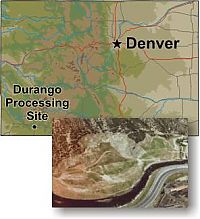
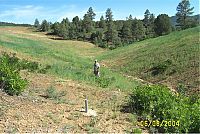
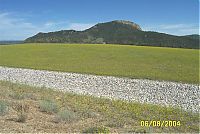
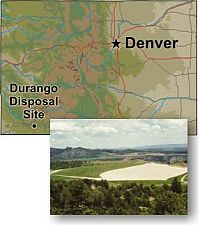
Location: The Durango mill site is located just southwest of Durango in La Plata County, Colorado.
Background: From 1880 to 1930 the American Smelting and Refining Company operated a lead smelter at the Durango site adjacent to the Animas River. At the beginning of World War II, the Reconstruction Finance Corporation (RFC), a Federal agency, acquired the smelter facility. RFC contracted with U.S. Vanadium Corporation to convert the facility to produce vanadium for Metals Reserve Company, which purchased strategic-materials for the Government during the war. In 1943-1944, U.S. Vanadium also operated a uranium-vanadium sludge plant at the site to process old vanadium mill tailings under contract with the Manhattan Engineer District. (The sludge was treated at U.S. Vanadium’s Grand Junction, Colorado, refinery where vanadium was removed and uranium was produced as black oxide.) The Durango mill produced vanadium until early 1944, when, with adequate vanadium stocks, Federal purchasing ended. At that time, U.S. Vanadium Corporation purchased the facility from RFC, and it continued to produce vanadium for commercial sales until the mill closed in August 1945.
The U.S. Atomic Energy Commission (AEC) purchased the 147-acre Durango mill site from U.S. Vanadium Corporation in 1948. Later that year, AEC leased the facility to Vanadium Corporation of America (VCA) with an option to purchase the plant at the end of the first lease period (1953). In late 1948, the first of three AEC uranium procurement contracts was signed with VCA. In 1949, production of uranium concentrates for sale to AEC began. Milling capacity was increased from 175 tons of ore per day (TPD) in 1953 to 750 TPD in 1958. From 1949-1963, mill throughput averaged about 350 TPD, and about 1.6 million tons of ore averaging 0.29 percent U3O8 and 1.55 percent V2O5 were processed. In 1953, VCA exercised its option to purchase the facility, and afterward the mill was operated as a private facility. VCA shut down the mill in March 1963, and it was later dismantled.
Ore for the mill came from numerous small mines in the Four-Corners area of Arizona, Colorado, New Mexico, and Utah. The plant also processed the uranium concentrate product from the Monument Valley, Arizona, upgraded facility; slime concentrates from the Naturita, Colorado, plant; and vanadium liquors bought from other producers. Uranium recovery averaged 80 percent and vanadium 70 percent from the combined mill feed. From 1949-1963, AEC purchased all of the mill's U3O8 production and its V2O5 production in excess of commercial demand. At the mill site, two tailings piles and one raffinate (milling process liquids) pond covering about 25 acres remained at the site before cleanup.
Background: From 1880 to 1930 the American Smelting and Refining Company operated a lead smelter at the Durango site adjacent to the Animas River. At the beginning of World War II, the Reconstruction Finance Corporation (RFC), a Federal agency, acquired the smelter facility. RFC contracted with U.S. Vanadium Corporation to convert the facility to produce vanadium for Metals Reserve Company, which purchased strategic-materials for the Government during the war. In 1943-1944, U.S. Vanadium also operated a uranium-vanadium sludge plant at the site to process old vanadium mill tailings under contract with the Manhattan Engineer District. (The sludge was treated at U.S. Vanadium’s Grand Junction, Colorado, refinery where vanadium was removed and uranium was produced as black oxide.) The Durango mill produced vanadium until early 1944, when, with adequate vanadium stocks, Federal purchasing ended. At that time, U.S. Vanadium Corporation purchased the facility from RFC, and it continued to produce vanadium for commercial sales until the mill closed in August 1945.
The U.S. Atomic Energy Commission (AEC) purchased the 147-acre Durango mill site from U.S. Vanadium Corporation in 1948. Later that year, AEC leased the facility to Vanadium Corporation of America (VCA) with an option to purchase the plant at the end of the first lease period (1953). In late 1948, the first of three AEC uranium procurement contracts was signed with VCA. In 1949, production of uranium concentrates for sale to AEC began. Milling capacity was increased from 175 tons of ore per day (TPD) in 1953 to 750 TPD in 1958. From 1949-1963, mill throughput averaged about 350 TPD, and about 1.6 million tons of ore averaging 0.29 percent U3O8 and 1.55 percent V2O5 were processed. In 1953, VCA exercised its option to purchase the facility, and afterward the mill was operated as a private facility. VCA shut down the mill in March 1963, and it was later dismantled.
Ore for the mill came from numerous small mines in the Four-Corners area of Arizona, Colorado, New Mexico, and Utah. The plant also processed the uranium concentrate product from the Monument Valley, Arizona, upgraded facility; slime concentrates from the Naturita, Colorado, plant; and vanadium liquors bought from other producers. Uranium recovery averaged 80 percent and vanadium 70 percent from the combined mill feed. From 1949-1963, AEC purchased all of the mill's U3O8 production and its V2O5 production in excess of commercial demand. At the mill site, two tailings piles and one raffinate (milling process liquids) pond covering about 25 acres remained at the site before cleanup.
10 files on 1 page(s)