

 Home
Home Register
 Login
Login Album list
 Last uploads
 Last comments
 Most viewed
 Top rated
 By date
 My Favorites
 Search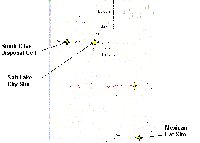
Green River Concentrator
Location: The Green River concentrator site is located in Grand County, Utah, and about one-half mile east of the Green River, one mile southeast of the City of Green River, Emery County, Utah.1
Background: The Green River concentrator was built by Union Carbide Corporation (UCC) in early 1958 and was operated from March of that year to January 1961. The original site covered about 80 acres. The plant shipped uranium concentrate and carbon concentrate products by rail to the UCC uranium mill at Rifle, Colorado, for final processing. Feed to the Green River concentrator plant consisted of sandstone-type ore that contained between 0.27 and 0.30 percent U3O8. The ore was poorly cemented with clay and asphaltic materials, and part of the uranium was contained in the carbonaceous fraction. The carbonaceous fraction was recovered separately by screening and flotation of the ground ore. The flotation product was stockpiled for later treatment. (Removing the carbonaceous fraction was necessary to prevent problems in processing the Green River product at the Rifle, Colorado, mill.) The remaining ground, coarse-ore fraction was mixed with recirculated acid solution and a sand-slimer separation was then made on this slurry. The sand fraction was then acid leached, and uranium was precipitated from the pregnant solution. The precipitate was mixed with the remainder of the primary slimes, and that product was dewatered, dried, and shipped to the Rifle mill. The concentrator processed uranium ore at an average rate of about 200 tons per day (TPD). Over the concentrator’s operating life, a total of some183,400 tons of ore averaging 0.26 percent U3O8 was processed. The concentrator also recovered vanadium from the ore, which averaged about 1.00 percent V2O5. Recovery of U3O8 averaged 87 percent; data for vanadium recovery are not available. Ore for the concentrator came primarily from mines in the Temple Mountain area of the San Rafael Swell and Green River districts in Emery County, Utah. Some 137,000 tons of tailings were generated by the concentrator over its operating life. Later, a flash flood swept away about 14,000 tons from the tailings pile, and in 1982 the pile was estimated to contain about 123,000 tons of tailings. After the concentrator was closed down, the 9-acre tailings pile was stabilized with a 6-inch thick earthen cover. An onsite pond was positioned to collect surface rainwater runoff from the pile. Later, buildings remaining at the site were used by the U.S. Army’s Utah Launch Complex of the White Sands Missile Range in New Mexico. The State of Utah acquired the concentrator plant site from UCC in 1988.
Background: The Green River concentrator was built by Union Carbide Corporation (UCC) in early 1958 and was operated from March of that year to January 1961. The original site covered about 80 acres. The plant shipped uranium concentrate and carbon concentrate products by rail to the UCC uranium mill at Rifle, Colorado, for final processing. Feed to the Green River concentrator plant consisted of sandstone-type ore that contained between 0.27 and 0.30 percent U3O8. The ore was poorly cemented with clay and asphaltic materials, and part of the uranium was contained in the carbonaceous fraction. The carbonaceous fraction was recovered separately by screening and flotation of the ground ore. The flotation product was stockpiled for later treatment. (Removing the carbonaceous fraction was necessary to prevent problems in processing the Green River product at the Rifle, Colorado, mill.) The remaining ground, coarse-ore fraction was mixed with recirculated acid solution and a sand-slimer separation was then made on this slurry. The sand fraction was then acid leached, and uranium was precipitated from the pregnant solution. The precipitate was mixed with the remainder of the primary slimes, and that product was dewatered, dried, and shipped to the Rifle mill. The concentrator processed uranium ore at an average rate of about 200 tons per day (TPD). Over the concentrator’s operating life, a total of some183,400 tons of ore averaging 0.26 percent U3O8 was processed. The concentrator also recovered vanadium from the ore, which averaged about 1.00 percent V2O5. Recovery of U3O8 averaged 87 percent; data for vanadium recovery are not available. Ore for the concentrator came primarily from mines in the Temple Mountain area of the San Rafael Swell and Green River districts in Emery County, Utah. Some 137,000 tons of tailings were generated by the concentrator over its operating life. Later, a flash flood swept away about 14,000 tons from the tailings pile, and in 1982 the pile was estimated to contain about 123,000 tons of tailings. After the concentrator was closed down, the 9-acre tailings pile was stabilized with a 6-inch thick earthen cover. An onsite pond was positioned to collect surface rainwater runoff from the pile. Later, buildings remaining at the site were used by the U.S. Army’s Utah Launch Complex of the White Sands Missile Range in New Mexico. The State of Utah acquired the concentrator plant site from UCC in 1988.
1 files on 1 page(s)