
NukeWorker.com: Nuclear Jobs, Resumes, Outage Schedules, & RCT Training

NukeWorker Menu

Nuclear Pictures

NukeWorker online photo album.

The Lowman mill site is in north-central Boise County, Idaho, about 73 miles northeast of the City of Boise. It is in the Boise National Forest one-half mile northeast of the village of Lowman (on State Road 21).
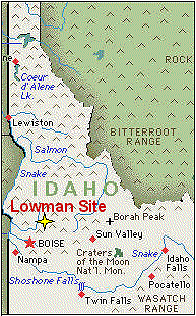
The Idaho batholith igneous complex extends about 300 miles N-S by 50 to 100 miles E-W in southwestern Idaho. It is comprised mainly of large intrusive bodies of medium to coarse-grained granite, quartz monzonite, and granodiorite. Pegmatite dikes are common in the granites. In this terrain, stream gravels and higher bench gravels contain placer deposits composed primarily of resistant, heavy-mineral grains (black sand) that were released from the batholithic rocks by weathering (decomposition and erosion). Placer deposits that formed in valleys that drain weathered quartz-monzonite outcrops contain a higher percentage of thorium-bearing minerals. These placers were mined for monazite (a thorium-bearing mineral) in the period 1903-1910 and again in the late 1940s. The thoria content of Idaho monazite is reported to be somewhat lower than other available commercial monazite concentrate.
Keywords: Lowman UMTRA

The Lowman mill site is in north-central Boise County, Idaho, about 73 miles northeast of the City of Boise. It is in the Boise National Forest one-half mile northeast of the village of Lowman (on State Road 21).


The Idaho batholith igneous complex extends about 300 miles N-S by 50 to 100 miles E-W in southwestern Idaho. It is comprised mainly of large intrusive bodies of medium to coarse-grained granite, quartz monzonite, and granodiorite. Pegmatite dikes are common in the granites. In this terrain, stream gravels and higher bench gravels contain placer deposits composed primarily of resistant, heavy-mineral grains (black sand) that were released from the batholithic rocks by weathering (decomposition and erosion). Placer deposits that formed in valleys that drain weathered quartz-monzonite outcrops contain a higher percentage of thorium-bearing minerals. These placers were mined for monazite (a thorium-bearing mineral) in the period 1903-1910 and again in the late 1940s. The thoria content of Idaho monazite is reported to be somewhat lower than other available commercial monazite concentrate.

NRC.low.level.disposalsites.gif 2002707.jpg bruce_l.jpg 2011456.jpg 2012481.jpg
File information
Filename:lowman.gif
Album name:Rennhack / Lowman Mill and Disposal Site
Rating (1 votes):55555
Keywords:Lowman / UMTRA
Filesize:30 KiB
Date added:Jan 24, 2006
Dimensions:196 x 316 pixels
Displayed:1215 times
URL:https://www.nukeworker.com/pictures/displayimage.php?pid=4589
Favorites:Add to Favorites